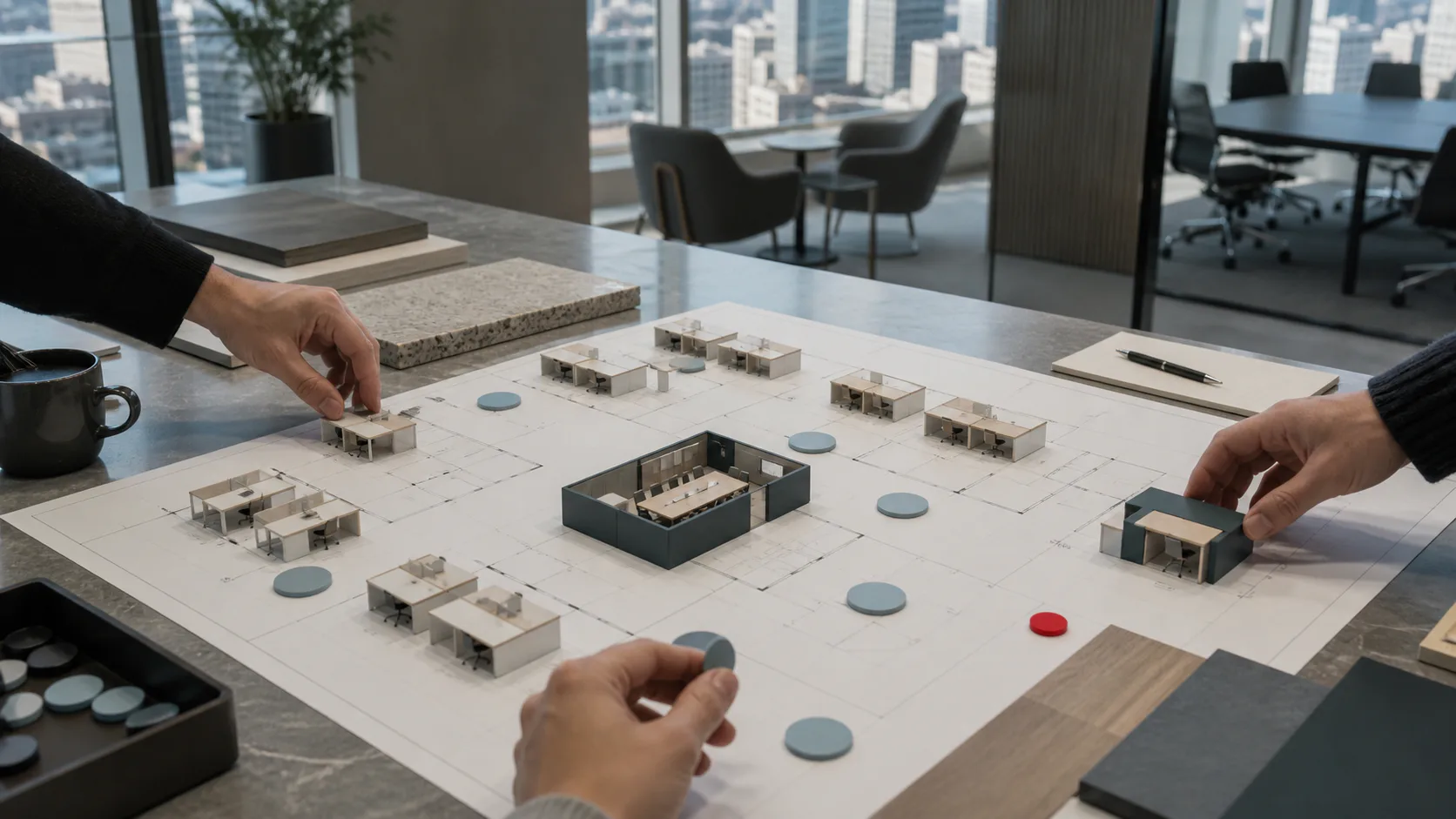
No universal rule of thumb is supported by the evidence. A serviced office is not automatically cheapest below some team size. A fitted office is not reliably the middle option. A conventional lease does not start winning at a fixed number of months.
What decides it is the exact rooms or premises, how many people are really in the office, the period you are comparing over, what each proposal actually includes, the cash you have to find before anyone can sit down, and what it costs to change or leave.
A monthly rent or a per-desk price cannot carry that on its own. What follows is a like-for-like method for comparing three real Hong Kong proposals over 12, 24 or 36 months. The editable model that goes with it keeps every assumption visible and will not name a cost leader until the commercial inputs are complete.
The workbook implements the calculation and gate logic described here. Its formulas were checked on 16 August 2026 across the five hypothetical brief structures below using synthetic QA inputs. That confirms that the workbook handles the intended horizons, seat paths and decision gates; it does not validate a market result. Publishing scenario results still requires three current, comparable proposals for each brief.
Download the editable 12–36 month office-format cost model (.xlsx)
The workbook implements the calculation and gate logic described here. Its formulas were checked on 16 August 2026 across the five hypothetical brief structures below using synthetic QA inputs. That confirms that the workbook handles the intended horizons, seat paths and decision gates; it does not validate a market result. Publishing scenario results still requires three current, comparable proposals for each brief.
First, define the three products
The market uses these names loosely. Classify by the agreement and the cost responsibilities, not the sales label.
| Format in this comparison | Working definition | Usually needs separate verification |
|---|---|---|
| Serviced private office | A private furnished room or suite supplied by an operator with a service package, under the operator's agreement | Exact room, practical capacity, access, air-conditioning, internet, meeting-room allowance, printing, mail, set-up, deposit or retainer, indexation, notice and restoration terms |
| Fitted direct lease | A direct lease of premises with an existing or landlord-provided fit-out the incoming occupier expects to keep | Fit-out condition and ownership, permitted alterations, furniture, IT and cabling, statutory or landlord approvals, management fees, rates, air-conditioning, repair, reinstatement and handback condition |
| Conventional lease with tenant fit-out | A direct lease under which the tenant designs, builds, equips and runs the workplace | Rent-free period, design and construction, furniture, IT and security, professional fees, approvals, pre-operational rent, delay risk, management and utilities, repair, reinstatement and exit |
A managed office combines dedicated premises, project delivery and ongoing services under a different contract again. If that is what has been offered, model it as a fourth option rather than quietly filing it under one of the three above.
And the legal character of an agreement cannot be read off its marketing label. Read the actual document, and take legal advice where it matters.
Five outputs, not one headline
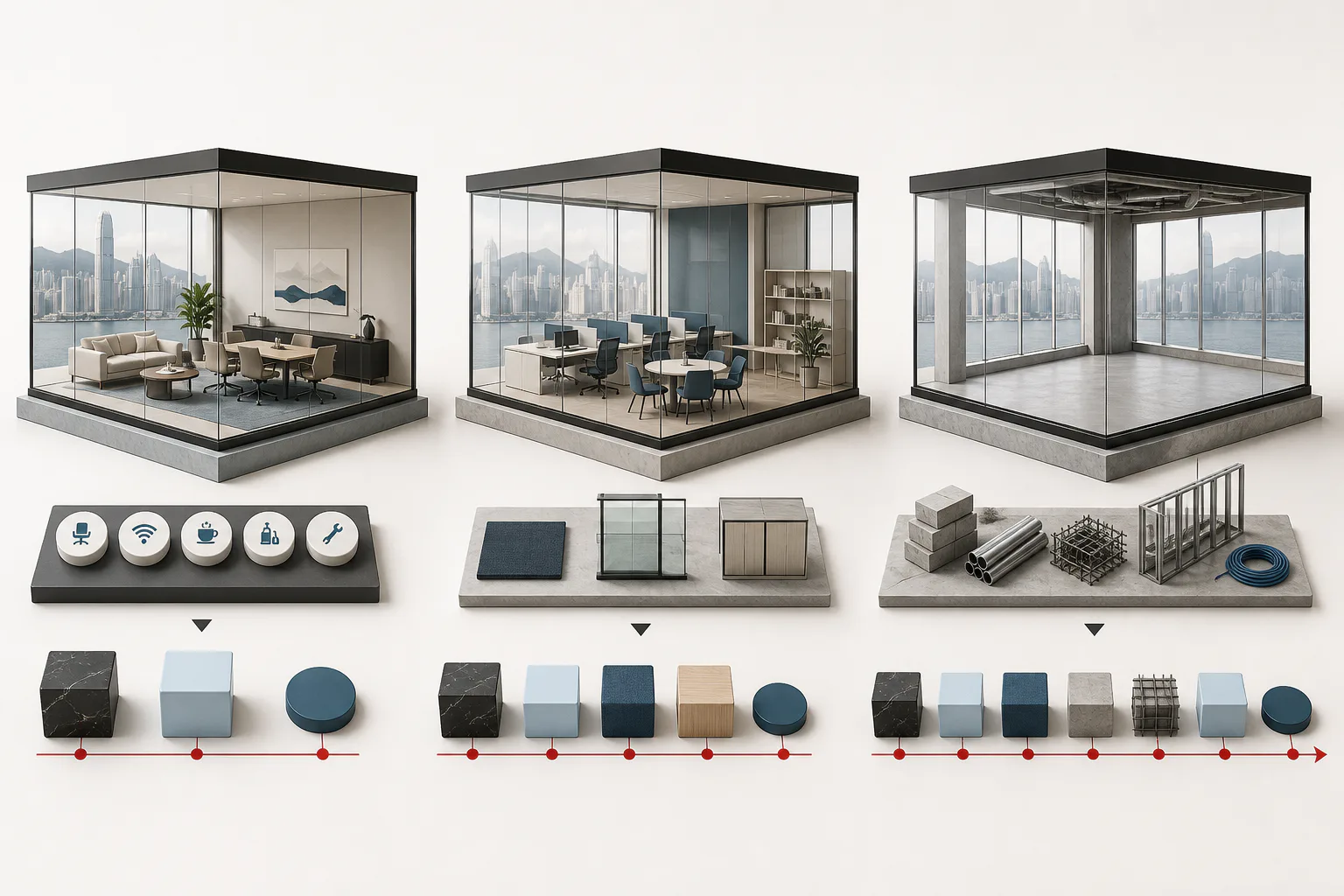
1. Non-refundable cost over the decision period. The cash cost assigned to your 12-, 24- or 36-month horizon:
recurring workspace and operating charges + one-off set-up and delivery costs + expected non-refundable deposit + exit costs − agreed contributions or cash credits
This is a planning measure, not an accounting, tax, valuation or legal conclusion. Anything falling outside the chosen period stays outside the result unless you enter it as a commitment attributable to this decision.
2. Initial cash before the office is usable. Deposit or service retainer, advance payment, fit-out and furniture, IT and security set-up, professional fees, moving costs, occupancy costs incurred before you can work there, and any overlap with the office you are leaving.
Advance payment is a timing item rather than an extra cost. The model puts it in initial cash but does not add it again to total cost where the same monthly charge is already counted — so confirm which months an advance payment actually covers.
3. Refundable cash tied up. A deposit is not automatically an expense. The model shows the expected refundable portion separately and counts only the expected non-refundable part as cost. That is a cash-planning assumption, not a prediction that anyone will make a particular deduction.
4. Cost per occupied seat-month. Dividing by contracted desks hides unused capacity, so the model uses expected occupied seats across months 1–12, 13–24 and 25–36:
total non-refundable cost ÷ expected occupied seat-months
This is what makes a 30-desk commitment for a 16-person team look visibly different from a 16-person room — without pretending everybody attends five days a week. Use whichever occupancy measure your company already uses, and keep it identical across all three options.
5. Readiness and capacity. A cheaper answer is not a viable one if the office cannot be ready in time or cannot hold the team at peak. The model reports readiness and capacity next to cost. Privacy, location, client experience, security, business continuity and agreement risk stay outside the formula entirely — they are gates, not line items.
The cost stack to normalise
Monthly workspace and operating cost
Take each item from the actual proposal instead of guessing at an all-inclusive figure:
- workspace charge or base rent;
- management fee;
- rates, and government rent where it is passed on;
- normal and out-of-hours air-conditioning;
- utilities, facilities and cleaning;
- internet, IT support and telephony;
- meeting rooms, printing, mail and reception;
- parking, storage or other recurring needs;
- the stated indexation or rent-review mechanism.
GovHK's office-renting guidance tells prospective occupiers to look past rent at rates, air-conditioning and management fees, and to check use and alteration restrictions, shared-facility access, term, rent review, renewal, early termination and repair obligations. It is a good list precisely because none of it appears in a headline number.
One thing that cannot be done here: dropping an official conventional-office rent series into a serviced-office column. The Rating and Valuation Department's office rents are net of rates, management and other charges, relate to tenancy commencements, and are general market references rather than quotations for a property. They can sanity-check a conventional base-rent assumption. The named-premises proposal supplies the model input.
One-off delivery and move-in cost
Depending on format and premises, enter operator activation or set-up; construction or adaptation; furniture; cabling, internet installation, access control and IT security; design, project management and other professional work; legal, agency and stamp duty; the move itself; rent and outgoings paid before the office is operational; overlap or double occupancy; any other non-refundable opening cost; and any landlord or operator contribution, with its timing and conditions attached.
JLL's 2026 Asia-Pacific fit-out guide is a useful dated planning reference for Hong Kong, but it is not a quotation. Scope, quality, existing condition, programme, technology, approvals and exclusions all move the number materially, which is why the model does not hard-code a fit-out benchmark into the comparison.
For stamp duty, use the current Inland Revenue Department calculator or professional advice against the real agreement terms. IRD notes that rent-free or varied-rent arrangements require total rent across the term to be considered, and that unusual terms may need adjudication. A generic spreadsheet rate would manufacture precision that isn't there.
Exit and restoration cost
Enter the written handback obligation rather than a format stereotype: restoration or reinstatement; removal, disposal and move-out; data and equipment decommissioning; expected deposit deduction; any other committed exit cost.
Formats do not behave here the way people assume. A serviced-office agreement can carry restoration, cleaning and service charges at the end. A fitted lease can require removal of additions or full reinstatement. A conventional lease may have handback terms that were negotiated down. Check all three.
What changes at 12, 24 and 36 months
The horizon changes how long recurring costs run and how many occupied seat-months absorb the one-off costs. It does not pick a winner by itself.
| Horizon | What it tends to expose | Questions to answer first |
|---|---|---|
| 12 months | Initial cash, mobilisation time, pre-operational cost, overlap and exit obligations carry high weight | Can each format legally and physically hit the start date? Which one-off costs remain unavoidable at month 12? Is a 12-month direct lease even on offer? |
| 24 months | Recurring differences become visible while one-off costs still matter | What changes after year one? Is growth accommodated in the same premises? Are rent-free months or credits conditional on the full term? |
| 36 months | Delivery costs spread across more seat-months, but indexation, capacity mismatch and exit exposure grow | Does the team still fit? Are renewal, break or expansion rights written down? What restoration and technology-refresh costs land at the end? |
Only run a horizon the proposal can credibly cover. Stretching a 12-month quote across 36 months needs a documented renewal or escalation assumption behind it. And a cancellable 12-month commitment and a non-cancellable 36-month lease are not the same risk, whatever the arithmetic says.
What the workbook has been tested for — and what it still has to prove
The workbook includes five hypothetical briefs, because a cost model that only works for one stable team is not decision-ready. We have run the formula mechanics across all five structures using synthetic QA inputs: 12-, 24- and 36-month horizons, stable and changing seat paths, and a fixed-date case in which late options correctly fail the readiness gate.
- an 8-person stable team, 12 months, fixed start date — stressing small size, short horizon and readiness;
- a 20-person stable team over 24 months — balancing recurring against one-off commitments;
- a 40-person stable team over 36 months — larger capacity, longer absorption;
- growth from 15 to 30 people across 36 months — early underuse against later expansion;
- a 30-person team, 24 months, fixed move date — fit-out delay, pre-operational rent and double-occupancy risk.
The formula mechanics have been tested; the market comparison has not. None of the five briefs has yet been run against three genuinely comparable, current proposals — serviced, fitted and conventional — for the same requirement. We do not have those evidence sets in hand. Until we do, the workbook is a tested calculation tool, not a validated market comparison, and we have not filled the gaps with invented prices to make it look finished.
These are hypothetical briefs in any case: not client cases, not market averages. When the scenarios are run, the results and their date will be published here.
A defensible workflow
Step 1 — lock the operating brief. Target start date, comparison horizon, expected occupied seats by year, practical peak attendance, required layout, hard location or transport requirements, access, air-conditioning, IT and security, visitor handling, meeting needs, and the point at which you expect to outgrow the space.
Step 2 — get three named options. For each format: the exact room or premises, the counterparty, practical capacity, expected ready-to-use date and proposal validity. A market rate is not a substitute for a live proposal.
Step 3 — normalise the inputs. Map each written line item into the same workbook. Enter zero only where the proposal or a responsible reviewer has confirmed there is no cost — a blank means unverified, and the two must never be allowed to blur.
Step 4 — separate cost from cash timing. Keep refundable deposits and advance payments visible. Record contributions only when the amount, the condition and the expected timing are all clear. Watch for double-counting an advance payment, or a cost already sitting inside a bundled charge.
Step 5 — run the horizons that are valid. Vary the period, headcount path, escalation and readiness assumptions. Where there is credible delay or overlap exposure, enter it as its own amount rather than burying it in fit-out.
Step 6 — apply the non-financial gates. Remove anything that fails on start date, capacity, privacy, security or access. What remains cheapest is a cost result, not a recommendation.
Step 7 — verify before deciding. Reconcile the workbook against the latest proposals, landlord and operator schedules, fit-out quotation, agreement and professional advice. Record the source date, and re-run after any commercial change.
Where these comparisons usually go wrong
- Multiplying a per-desk headline by headcount while ignoring the exact room and its minimum billable capacity.
- Assuming everything in a serviced proposal is included, without checking allowances and extras.
- Setting serviced total occupancy cost against conventional base rent that excludes management fees, rates and other charges.
- Treating a refundable deposit as both a full expense and an additional cash item.
- Counting advance rent twice.
- Assuming an inherited fit-out removes all furniture, IT, adaptation, approval and reinstatement cost.
- Applying a citywide fit-out benchmark to a named project with no scope or condition evidence.
- Ignoring rent-free conditions, contribution timing or pre-operational outgoings.
- Spreading one-off costs across 36 months when the company expects to leave at 12 or 24.
- Using contracted desks instead of realistic occupied seat-months.
- Calling a hypothetical scenario a case study.
Frequently asked questions
Is a serviced office always more expensive per month?
Not on a comparable basis. A serviced proposal bundles items that sit outside conventional base rent, and it also carries usage-based extras. Compare the full recurring stack for the exact room over the exact period.
At what team size does a conventional lease become cheaper?
There is no universal threshold. Area efficiency, fit-out scope, term, rent-free period, services, how well the capacity is used, delivery timing and exit obligations all move it. Run your current proposals through the same model.
Is a fitted office automatically cheaper than building one?
No. An existing fit-out removes some delivery work, but its condition, layout, ownership, IT readiness, adaptation needs and handback obligation all need verifying — and it may simply not suit the team.
Should the deposit be included in total cost?
Show the cash tied up, but not the whole deposit as cost. The model counts only the expected non-refundable portion and keeps the refundable amount separate. What actually happens depends on the agreement and the handback.
Can I use RVD average rent as the conventional quote?
No. RVD describes its averages as general references that shift with the mix of properties, and they are net of rates, management and other charges. Use the landlord's proposal for the named premises.
Does the spreadsheet give legal or financial advice?
No. It is a transparent cash-comparison tool. Agreement classification, stamp duty, accounting treatment, tax, fit-out compliance and legal obligations all need the appropriate professional review.
Build the comparison from current options
Tell us the target district or transport requirement, expected occupied seats, peak attendance, move date, term range, layout and operating requirements. We can source serviced-office options, organise the evidence and proposals a like-for-like comparison needs, and coordinate viewings and commercial discussions. Legal, tax, accounting, valuation and technical advice stay with the relevant advisers.
Compare serviced offices in Hong Kong
Sources and methodology
- GovHK — Renting an Office, last reviewed May 2025; accessed 9 August 2026.
- Rating and Valuation Department — Hong Kong Property Review Monthly Supplement, August 2026, office rental tables; accessed 9 August 2026.
- Rating and Valuation Department — Technical Notes, rent and average-rent limitations; accessed 9 August 2026.
- Rating and Valuation Department — Rates and Government Rent Calculator, current 2026/27 reference; accessed 9 August 2026.
- Inland Revenue Department — Stamp Duty Computation: Tenancy Agreement and e-Stamping FAQ; accessed 9 August 2026.
- JLL — Asia Pacific Fit-Out Cost Guide 2026, published 6 May 2026; accessed 9 August 2026.
- Regus — Global Terms and Conditions, March 2026 and Hong Kong office-space product page, cited only as one operator-specific example of agreement and service variation; accessed 9 August 2026.
Every monetary input in the model should come from a dated proposal, agreement, project quotation or responsible adviser. Public market data is context, not a substitute for the exact option in front of you.