Current MOA catalogue data
Current MOA catalogue coverage by format
Data as of 2 October 2026
Serviced offices
Coworking
Coverage is compared by buildings and operators. Raw catalogue records are not a like-for-like product count: a record may describe an individual room, a centre or a membership product. These figures describe MOA catalogue coverage, not market share or live room availability, and they are not used to calculate a serviced-versus-coworking price distribution.
Take an enclosed private office when your team needs control of a room rather than access to a desk. Take a coworking membership when flexible access matters more than keeping one space permanently reserved. A dedicated desk sits in between: the seat is yours, the room around it is not.
That is the short version. The real decision turns on eight operating requirements — confidentiality, attendance, client arrival, IT, access, meeting rooms, company identity, and what the whole team ends up paying.
Download the workspace-format decision matrix (.xlsx)
Two things to declare before we start
We are a private-office specialist. That is our core search work, and it shapes what we see first. The current catalogue covers serviced offices across 76 buildings from 21 operators. Coworking coverage is narrower but real, across 27 buildings from 10 operators. Those figures describe MOA catalogue coverage, not the Hong Kong market. We compare the formats by buildings and operators because raw catalogue rows are not a like-for-like product count: a row may describe an individual room, a centre or a membership product. Coworking rows can also represent different product subtypes, so we do not publish a serviced-versus-coworking price distribution. A comparison guide written by someone with a commercial interest should show its hand, so there it is.
The operator examples are illustrations, not standards. We quote Eaton Club, WeWork, HTEBC, the Hive and The Executive Centre because their product pages are public and specific. Each describes that operator's own arrangement on that date. None establishes a Hong Kong norm, and none tells you what your proposed agreement says.
The terminology is misleading
"Serviced office versus coworking" is how people search, but it compares a business model with a product.
One serviced-office operator will run private offices, coworking desks, meeting rooms and larger managed suites in the same centre. A company everyone calls a coworking brand will happily sell you an enclosed room. Eaton Club describes its private office as a dedicated office inside its coworking community, and sells lifestyle memberships, dedicated desks, day offices and day passes from a separate page.
So the comparison worth making is between three products:
- Hot desk or access plan — any available seat or shared area, under the rules of a day pass or membership.
- Dedicated desk — a specific reserved workstation inside shared workspace.
- Private serviced office — an enclosed room reserved for one company, with reception, meeting rooms, lounges and kitchens still shared outside it.
Even those are descriptions rather than packages. Access, guest rules, storage, address use, meeting rooms and IT all vary by operator, location and plan.
The decision in one table
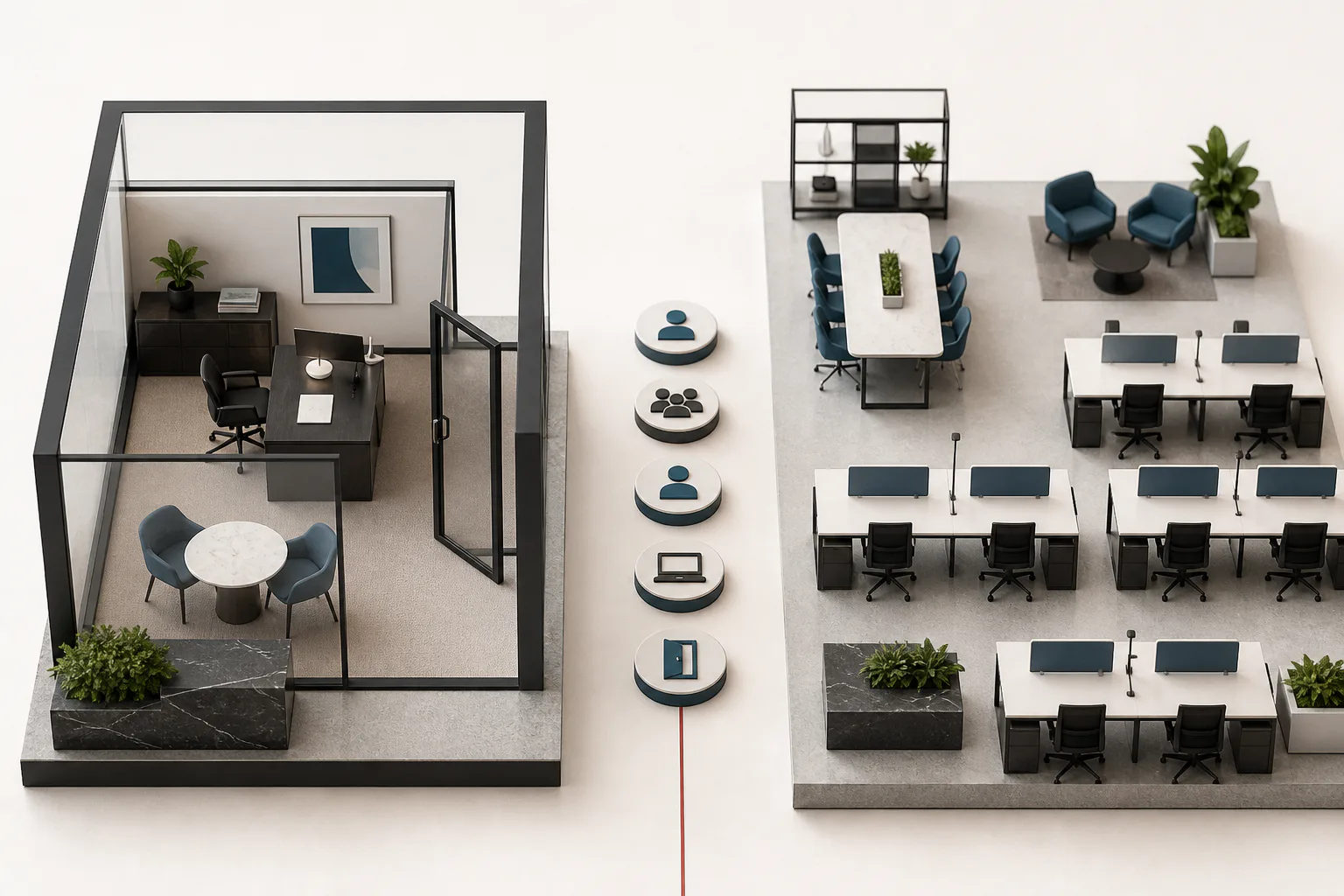
| Operating need | Lean toward a hot desk, dedicated desk or access plan when… | Lean toward a private office when… | Verify before deciding |
|---|---|---|---|
| Confidential calls and documents | Sensitive work is occasional and bookable rooms or booths are a workable routine | Sensitive calls, screens or paper are part of normal daily work | Acoustic privacy, booth/room availability, storage and access control |
| Fixed versus changing attendance | Attendance is intermittent or people need different locations | A stable team needs the same room, layout and equipment | Named-user rules, transferability, simultaneous seats and peak attendance |
| Client arrival and reception | Clients visit rarely or a bookable meeting room provides the right experience | Frequent visitors need a predictable route, room and team presence | Guest policy, reception hours, room availability and visitor access |
| IT and security | Standard shared connectivity and portable equipment meet the requirement | The team needs a controlled room, wired setup or private network options | Network design, cabling, device rules, support and contractual limitations |
| Access and meeting rooms | The chosen plan covers the required days, locations and bookings | The team needs continuous room access and regular internal space | Building/centre hours, credits, overage, cancellation and after-hours AC |
| Company identity and address | A shared environment and plan-level address/mail service are sufficient | The company needs a persistent team room or more visible identity | Address permission, mail, directory, signage and branding cost |
| Growth or project duration | Users or locations may change frequently and the plan can be adjusted | The team is stable enough to use a room or needs space kept together | Change process, availability, minimum term, notice and new fees |
| Total monthly commitment | The complete membership and usage cost stays below a suitable room quote | The room replaces enough memberships, meeting use, storage or add-ons | Whole-team recurring cost, initial cash and unused capacity |
It is not a points test. A single hard requirement — daily confidential work, or a private-network dependency — can outweigh several softer preferences on the other side.
1. Confidential calls and documents
An enclosed room gives you more physical control than a seat in an open area. It does not prove the room is soundproof, that glass partitions hide screens, or that the operator has no right of entry under the agreement.
Start from the work pattern:
- How many people take confidential calls at the same time?
- How long do those calls run?
- Are phone booths acceptable, or does the person need to stay at their desk?
- Do files, prototypes or equipment stay out overnight?
- Can sensitive meetings be scheduled around room availability?
One consultant making two short private calls a week can work happily on a coworking plan with reliable booths. Six people handling sensitive calls all day cannot: repeatedly relocating to shared booths is a different operating model, not a cheaper version of the same one.
WeWork's product comparison separates a fully enclosed private office from a reserved desk in shared workspace and from drop-in lounge access — a useful illustration of how the products differ, though not evidence that every enclosed room performs the same acoustically.
Test it at the viewing. Close the door, take a call at normal volume, then stand outside and listen. Check the sightlines to screens and paper. Ask who can enter the room, and when.
2. Fixed versus changing attendance
Comparing payroll headcount with room capacity will mislead you. Write down four numbers instead:
- total named employees who may use the workspace;
- normal daily attendance;
- peak simultaneous attendance;
- workpoints that must stay permanently set up.
The reason is that a membership may belong to one named person and may not be shareable. An eight-person hybrid team with three people in on a typical day cannot assume three memberships will cover it — the operator may want individual memberships, day passes, credits or an enterprise plan for every eligible user.
At the other end, a private room is paid for as a room whether the desks are full or empty. That unused capacity can still be worth it if the team needs a permanent setup, storage, somewhere to take calls or a stable base. It is not automatically economical just because several people sit there.
Within shared workspace, three products behave differently:
- hot desk — no permanent seat, subject to availability and booking rules;
- dedicated desk — a reserved seat, often with different access and storage rights;
- access membership — permission to use participating locations, or a set number of days.
HTEBC's Hong Kong page shows the distinction inside a single centre: its hot desk is any available desk during stated hours, while its dedicated desk carries reserved use, wider access and storage.
3. Client arrival and reception
Coworking is not inherently unprofessional, and a private office does not come with a private reception. Some centres sell both products at the same address, sharing the same lobby, reception, lounges and meeting rooms.
Walk the client's actual journey:
- Can a visitor enter the building without being collected?
- Who greets them, and during what hours?
- Where do they wait?
- Does the membership allow guests outside a booked meeting room?
- Can you book a suitable room at the times you normally meet people?
- Does the client cross an open work area to reach it?
- Whose name appears at reception, on the directory and at the office door?
A consultant meeting one client a month may be better off on a membership, paying for the right room only when it is needed. A team seeing visitors weekly will value a permanent base — but still has to check meeting-room supply and how reception hands guests over.
"Access to meeting rooms" is not an answer to any of this. Get the included credits, member rates, peak availability, cancellation rules and guest policy in writing.
4. IT, networks and physical security
The real distinction is not shared Wi-Fi versus private office. A private room may run on the same shared centre infrastructure as the lounge, and a coworking operator may sell private networks and enhanced IT.
Send the operator a short requirements sheet covering:
- shared Wi-Fi and wired connectivity;
- dedicated bandwidth or private network needs;
- fixed IP, firewall, VLAN or guest-network requirements;
- permission for cabling or your own equipment;
- support coverage and escalation;
- backup connectivity;
- monitor and equipment storage;
- screen and paper-document controls;
- access-card administration and leavers.
Then compare the written answers and the agreement rather than the phrase "business-grade internet". WeWork's private-office page separates standard connectivity from optional dedicated-bandwidth and private-network configurations, which shows how easily advanced IT becomes a second, separately priced decision.
For regulated or security-sensitive work, the workspace format is one control among many. Your own IT, security, compliance and legal reviewers should look at the actual setup.
5. Access and meeting-room use
Access comes in layers: building entry, centre entry, your desk or room, other locations, staffed reception hours, and air-conditioning outside normal building hours. Plan names answer none of them.
the Hive's Wan Chai membership table sets different access hours, meeting-room credits and printing credits across hot-desk, dedicated-desk and private-office plans. The Executive Centre's Hong Kong coworking FAQ notes that private-office and dedicated-desk memberships are treated differently from standard city and global passes, and that centre amenities vary.
Rather than ticking meeting rooms as a yes/no feature, cost your actual use:
expected monthly room cost = hours above included allowance × applicable room rate
Then test availability. A generous credit is worth very little if the room size and time slot your team needs are always taken.
6. Company identity, address and mail
A private office may give you more visible identity, but signage and address rights are contractual either way. Some coworking memberships include a mailbox or business address; others require a virtual-office add-on.
Confirm each of these separately: website and correspondence address use; registered-office use if you need it; how mail and parcels are received, notified, stored and forwarded; your company name at reception or on the directory; door and internal signage; how visitors are announced; and what happens to mail once the agreement ends.
Paying for a desk does not authorise every form of address use, and an enclosed room does not automatically come with branding. Match your exact legal entity and intended use to the operator's written permission.
7. Growth, contraction and project duration
Coworking makes changing attendance easier in principle, but "flexible" needs a mechanism behind it. A private-office operator may allow moves within its network, while a dedicated desk or access plan can still carry a minimum term and named-user rules.
Ask:
- Can users be added or removed mid-term?
- Can a dedicated desk convert to a private room?
- Can a private room expand without changing centres?
- Is any change subject to availability or minimum spend?
- Does a change trigger a new agreement, term, deposit or activation fee?
- What notice applies?
- Can the operator move you?
- Do unused credits travel?
Match the answers to your scenario. A three-month project team wants the ability to stop. A stable Hong Kong team wants to keep one room and negotiate expansion rights into the agreement. A fast-growing team needs to compare both what is available today and the process for the next move.
8. Total monthly commitment
The cheapest advertised desk is not the lowest team cost, and a private room does not become better value at some fixed headcount.
For a hot desk, dedicated desk or access plan:
memberships or passes for all eligible users + reserved-seat and storage charges + expected meeting-room or day-office use + address, mail, printing and other mandatory add-ons
Show named users and peak simultaneous seats separately. Confirm whether the plan transfers between people and whether everyone needs their own membership.
For a private serviced office:
whole-room monthly quotation + mandatory recurring services + expected meeting-room, printing, access, air-conditioning and IT usage outside the package
Keep the operator's billable capacity next to your team's practical capacity. A nominal six-desk room may be too dense for the layout you want, or it may absorb enough external meeting and call-space usage to justify itself.
Keep upfront cash separate. For both products, record the deposit or service retainer, setup and activation and access-card charges, the first payment date, any promotion conditions, the minimum term, renewal and notice, and exit or damage obligations.
GovHK's office-renting guidance notes that general office facilities usually accompany a serviced-office rental and that some providers also offer meeting rooms or secretarial services — without defining a standard package, because there isn't one. The complete proposal is what you compare.
Why there is no universal break-even headcount
Any "a private office wins above X people" rule ignores too much:
- a hot-desk plan may be priced per named user, per day or by credits;
- a dedicated desk is a different product and price from an unreserved seat;
- a private room may be priced on billable capacity rather than attendance;
- meeting-room and booth use can move the shared-workspace total substantially;
- district, building, room position and term all move private-office quotes;
- some teams value permanent equipment and privacy above the per-seat maths;
- a hybrid team can badly underuse a room it is paying for in full.
Run both calculations on current proposals. When the numbers land close together, decide on operational fit rather than manufacturing a mathematical winner.
Four common scenarios
One mobile consultant working across Hong Kong. A hot-desk or multi-location plan may fit, provided calls can move to booths or bookable rooms and the guest and address rules work. Add a day office when a real room is needed. Check booking availability and the total usage cost, not the headline membership.
Two people full-time, with monitors and files. Compare two dedicated desks against the smallest suitable private room. The answer turns on storage, named-user pricing, room capacity, call privacy, meeting use and whether the room is simply too big.
A client-facing team with daily calls. An enclosed room removes the constant migration to booths and gives clients a consistent destination. Test acoustic privacy, reception, meeting-room supply and visitor access anyway — the word "private" proves none of them.
A larger hybrid team with low average attendance. Do not price the average. Establish whether every eligible employee needs their own access rights, then compare an enterprise plan, day passes and a smaller private room using both named users and peak attendance.
What to check at the viewing
For a shared product: arrive at the hour your team would normally work and see whether suitable desks are genuinely free. Count the booths and look at how they are booked. Take a call at normal volume and listen to what surrounds it. Ask how guests get in and where they wait. Check the storage, monitor and equipment rules.
For a private office: confirm the exact room and layout being quoted. Test speech privacy from outside the door and through adjoining walls. Check desk spacing, storage and circulation at your practical capacity, not the operator's. Walk the client route from lobby to room. Verify access, air-conditioning and IT for your specific plan. And check whether the photographs show this room or only the shared areas.
Neither format should be chosen from lounge photography. The decision lives in the exact desk or room, and in the agreement attached to it.
Frequently asked questions
Is a private office always a serviced office?
Not as a matter of universal terminology. In this guide, "private serviced office" means an enclosed team room operated inside a flexible, operator-managed centre. Operators use their own product and agreement names.
Is coworking only for freelancers and startups?
No. Operators sell coworking and access products to individuals, project teams and companies alike. The better question is whether a given plan supports your users, privacy, clients, IT and working hours.
Is a dedicated desk private?
It reserves a workstation. The environment around it stays shared unless the specific product says otherwise. WeWork describes its dedicated desk as a reserved desk in shared workspace; HTEBC distinguishes its dedicated desk from both hot desks and private offices.
Is coworking always cheaper than a private office?
There is no supportable universal answer. Compare the complete cost for all named users and expected usage against the whole-room quote and its practical capacity.
Does a private office guarantee confidentiality?
No. It gives you more physical control than an open seat. Acoustic construction, access rights, networks, meeting-room use and day-to-day procedure all still need checking.
Can you help with both formats?
Private serviced offices are our core search work, and that is worth knowing before you read the comparison. The current coworking catalogue spans 27 buildings from 10 operators. Use this guide to work out whether an enclosed room actually fits the team. If the table points you toward a shared product, start with the coworking catalogue and confirm the product subtype, access and membership rights with the operator.
Choose the next search path
If the team needs an enclosed room, compare current private-office options by location and capacity.
Compare private offices in Hong Kong
For the wider operator-managed model — private rooms, coworking and larger managed suites in one view:
Explore serviced offices in Hong Kong
If you have landed on hot desks or an access plan, start with our current coworking options, then confirm the product subtype, access and membership rights with the operator.
Sources and research boundary
- My Office Asia published Hong Kong catalogue, live read-only coverage; the coverage figures carry their own data date. The coverage figures describe MOA inventory, not the Hong Kong market.
- Current operator-supplied materials reviewed 9 August 2026. No confidential room pricing is reproduced.
- GovHK — Renting an Office or Business Premises, last review shown as May 2025; accessed 9 August 2026.
- Eaton Club — Coworking Membership and Private Office, accessed 9 August 2026.
- HTEBC — Co-working Space, accessed 9 August 2026.
- the Hive Wan Chai — Memberships, accessed 9 August 2026.
- The Executive Centre — Hong Kong Coworking and Private Office, accessed 9 August 2026.
- WeWork — Private Office and Dedicated Desk, accessed 9 August 2026.
- Regus — Causeway Bay Office Products, accessed 9 August 2026.
- Compass Offices — Hong Kong Serviced Offices, accessed 9 August 2026.