Current MOA catalogue data
MOA catalogue coverage across the nine launch districts
Data as of 1 October 2026
| District | Listings | Buildings | Operators | Price evidence |
|---|---|---|---|---|
| Central | 28 | 18 | 13 | Search only — price sample below gate |
| Admiralty | 7 | 4 | 4 | Search only — price sample below gate |
| Wan Chai | 9 | 6 | 6 | Search only — price sample below gate |
| Causeway Bay | 13 | 10 | 9 | Search only — price sample below gate |
| Sheung Wan | 8 | 7 | 6 | Search only — price sample below gate |
| Tsim Sha Tsui | 20 | 9 | 7 | Search only — price sample below gate |
| Mong Kok | 9 | 4 | 3 | Search only — price sample below gate |
| Kwun Tong | 7 | 5 | 4 | Search only — price sample below gate |
| Quarry Bay | 5 | 3 | 3 | Search only — price sample below gate |
Counts describe published MOA catalogue breadth, not Hong Kong market supply or room availability. District prices are published only with at least 10 fresh prices, three operator-building groups and two operators.
There is no best Hong Kong office district. The right one passes your team's hard requirements, shortens the journeys they make most often, and still produces suitable rooms at a total cost the business can live with.
That is a more useful test than the usual shorthand — Central for finance, Causeway Bay for retail, Kwun Tong for startups. An industry label tells you nothing about where your people begin their commute, which client buildings they visit, how often somebody runs to the airport, or whether the actual room works.
Download the Hong Kong office-district decision matrix (.xlsx)
Four stages:
- identify the locations and access conditions that cannot move;
- measure the journeys your team and visitors actually repeat;
- check current serviced-office choice and how strong the price evidence is;
- compare and view exact rooms, not district reputations.
One principle before anything else: the building decides, not the district
This comes up in every section below, so it is worth stating once properly.
A district name is an average of buildings that can behave completely differently. Two Central addresses can sit ten minutes and one interchange apart. Hysan Place has a specific station exit; the building down the road does not inherit it. Taikoo Place is served by two stations through an internal walkway; a Quarry Bay tower without that walkway is a different commute in the rain.
So every piece of building-level evidence in this article — an official access page, a station exit, a covered walkway — applies to that building. Use it for the option in front of you, then walk the route to anything else. We will not repeat the warning nine times; assume it applies throughout.
Start with a journey map, not a district shortlist
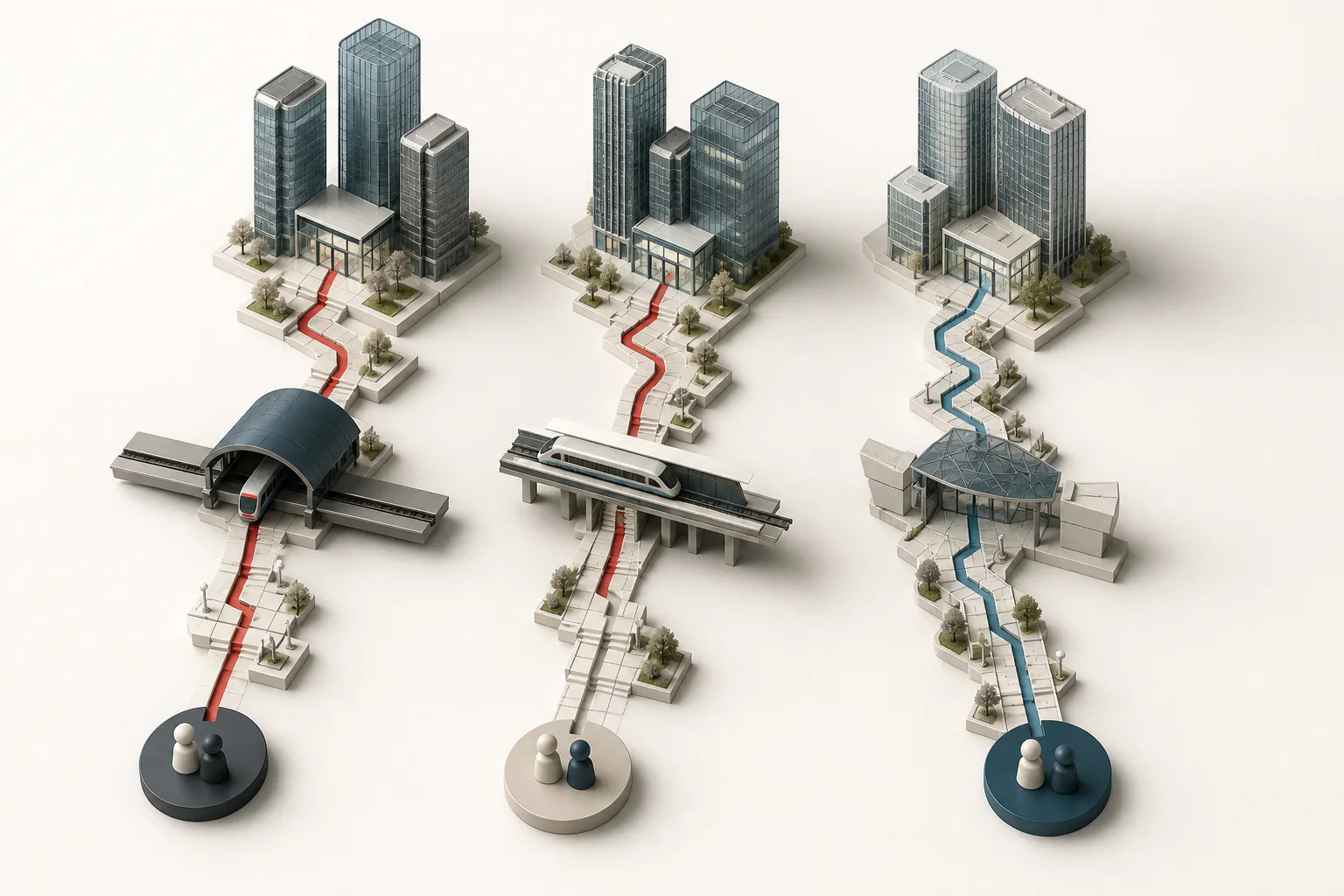
Before naming a preferred area, write down:
- the home-station clusters your team travels from, and office days per week;
- the exact client, court, government, venue, partner or group-office destinations visited repeatedly;
- monthly airport, high-speed rail, cross-border rail and ferry journeys;
- any address, building, accessibility or visitor-arrival requirement;
- peak attendance, room layout, target start date, term and total monthly budget.
These are the inputs we need before scanning the market too. "Near a transport hub" is not a brief until someone says which hub, who uses it and how often.
For every candidate building, start from the official MTR system map and station location maps, then test the whole route from platform to office door. A district can contain several stations and wildly different final walks. A line on a map will not show you the right exit, a long interchange, an uncovered crossing, or the route a first-time visitor takes.
Current serviced-office choice by district
MOA catalogue coverage is discovery evidence, not a census of Hong Kong offices or live room availability for a given start date. Several published rooms can sit inside one building, so building and operator spread matters more than a raw listing total.
A district can produce a useful shortlist before its price sample is broad enough to support a median. We publish a district price only with at least ten fresh priced listings, three operator-building groups and two operators. The dated serviced-office price benchmark explains the method; decisions still require room-level proposals.
Rail connections, verified
This records what connects where. It does not claim every office in a district is equally convenient.
| District | Relevant MTR stations and lines | Additional connection worth testing | Important qualification |
|---|---|---|---|
| Central | Central: Island and Tsuen Wan. Hong Kong: Tung Chung and Airport Express. | Airport Express at Hong Kong station. | Hong Kong and Central stations are connected, but the platform-to-building route varies materially across the district. |
| Admiralty | Admiralty: Island, Tsuen Wan, East Rail and South Island. | One station, four lines interchanging. | A direct building connection and an outdoor walk are not the same arrival. |
| Wan Chai | Wan Chai: Island. Exhibition Centre: East Rail. | Wan Chai–Tsim Sha Tsui ferry, for a harbourfront route. | Wan Chai station, Exhibition Centre station and Queen's Road East serve different micro-locations. |
| Causeway Bay | Causeway Bay: Island. | Tram or road routes may matter for some origins. | Offices sit across distinct streets and complexes; the station name does not fix the final route. |
| Sheung Wan | Sheung Wan: Island. | Hong Kong–Macau Ferry Terminal, for a specific cross-border pattern. | Terminal proximity and sailing suitability are building- and itinerary-specific. |
| Tsim Sha Tsui | Tsim Sha Tsui: Tsuen Wan. East Tsim Sha Tsui: Tuen Ma. | Star Ferry to Central and Wan Chai. | Two separate gated stations. West Kowloon high-speed rail is not a Tsim Sha Tsui station. |
| Mong Kok | Mong Kok: Tsuen Wan and Kwun Tong. Mong Kok East: East Rail. | East Rail for New Territories or boundary-station journeys. | Two separate stations; a building near one does not sit on all three lines. |
| Kwun Tong | Kwun Tong: Kwun Tong line. Ngau Tau Kok serves some addresses in the wider area. | Road, minibus or company shuttle routes can change the answer. | Use the exact building, exit and employee origins; the district label is too broad. |
| Quarry Bay | Quarry Bay: Island and Tseung Kwan O. | Two-line interchange cuts transfers for some eastern and TKO origins. | Strong transport does not guarantee a broad shortlist; keep another operationally valid district in the search. |
MTR's map confirms these lines, and lists Tsim Sha Tsui and East Tsim Sha Tsui separately, as it does Mong Kok and Mong Kok East. MTR's fare guidance permits a walking interchange between the two Tsim Sha Tsui stations under stated conditions — which does not make them one station.
For high-speed rail, the official Hong Kong West Kowloon Station guide identifies direct pedestrian access to Austin and Kowloon stations. It does not name Tsim Sha Tsui. If high-speed rail is a recurring requirement, measure the route from each exact office rather than handing Tsim Sha Tsui an automatic advantage.
District by district
Central
Shortlist Central when the team has repeated destinations there, when the address is a genuine requirement, or when Hong Kong station meaningfully shortens frequent airport runs. Treat its distinct micro-locations and buildings as separate products rather than assuming the district delivers one journey or one price level.
The transport benefit is not evenly spread. The ifc complex sits above Hong Kong station with a described connection to Central station; an office at the far side of the district is a different journey entirely. Compare exact destinations and building exits before paying for the postcode.
View serviced offices in Central
Admiralty
Admiralty earns its place on the interchange. Four lines meet at one station, which can remove repeated transfers for teams whose people arrive on the Island, Tsuen Wan, East Rail or South Island lines.
Pacific Place's access information puts that complex directly above Admiralty Exit F. Admiralty's office search is concentrated around a four-line interchange and a limited set of large commercial complexes. Compare real proposals against Central and Wan Chai rather than assuming a discount in either direction.
Wan Chai
Wan Chai is several micro-locations wearing one name. A team visiting the convention centre may want Exhibition Centre station or the harbourfront; another needs Wan Chai station or Queen's Road East. The HKCEC transport page lists routes from both stations, which is the point: the destination decides, not the district.
Wan Chai's micro-locations differ enough that transport, building fit and proposal terms should be assessed before price. Treat each building and operator as separate evidence rather than inferring one district price from several room listings.
View serviced offices in Wan Chai
Causeway Bay
Shortlist Causeway Bay when employee and client journeys work on the Island line and the destinations genuinely sit here. The habit of assigning it to retail, creative or consumer businesses tests nothing about journeys or rooms.
Choice is spread across multiple operators and buildings, making it worth comparing different operators as well as different addresses inside the district. Hysan's Lee Gardens access page identifies Causeway Bay Exit F2 for Hysan Place and the estate — use it for those buildings and walk the route to anything else.
View serviced offices in Causeway Bay
Sheung Wan
Worth a look when the Island line, western Central access or a specific Sheung Wan destination cuts repeated travel. If Macau or other ferry journeys are genuinely frequent, a building near Shun Tak Centre may matter — Shun Tak's own reporting confirms the complex houses the Hong Kong–Macau Ferry Terminal. Current sailings and the full office-to-departure journey still need checking separately.
Treat the district as a starting point, then confirm a real room and proposal. Ferry access matters only when the exact building and current sailing pattern make it practical for repeated journeys.
Tsim Sha Tsui
Shortlist Tsim Sha Tsui when Kowloon-side routes, the Tsuen Wan line, the Tuen Ma line or the Star Ferry shorten real journeys. Decide first which side of the district you need — the two rail stations connect by a walking transfer but have separate gates, and an office near one is not automatically near the useful exit of the other.
One thing to get right: this district is not directly connected to high-speed rail. West Kowloon connects to Austin and Kowloon. Tsim Sha Tsui may still produce a perfectly workable route by road or rail, but it has to be measured rather than assumed. Its mix of buildings and operators can support a practical search, while price evidence and room availability still need current verification.
Mong Kok
Mong Kok works when the Tsuen Wan or Kwun Tong lines suit the team's routes, or when a specific building near Mong Kok East makes East Rail useful. Keep the two stations apart in the comparison — they are not interchangeable.
Several published rooms can still be concentrated in a small number of centres. Test actual proposals rather than the general belief that Mong Kok is cheaper.
Kwun Tong
Shortlist Kwun Tong when employee origins, client destinations or operational partners make it work in practice. The district guides that call it affordable and tech-friendly are not evidence of current serviced-office cost or fit.
Do not infer price or breadth of choice from Kwun Tong's district reputation. The MTR map lists both Kwun Tong and Ngau Tau Kok on the line — confirm which station and exit serves each building, then walk it at the hour your team would.
Quarry Bay
Quarry Bay belongs in any serious comparison because of the Island and Tseung Kwan O interchange, which can transform journeys for eastern and TKO origins. Taikoo Place's access page describes that development as served by two stations through an internal walkway network.
The transport case is stronger than the supply. Include Quarry Bay in the travel test, but keep a better-covered alternative alive until a suitable room and a real proposal are confirmed.
The decision matrix
Scoring each district out of five hides the reasoning. Use hard gates and visible quantities instead.
Step 1: apply the hard gates
Mark every non-negotiable Pass, Fail or Unverified for each district:
- required address, building or destination;
- maximum acceptable journey for a critical employee group;
- step-free route or other accessibility requirement;
- visitor-arrival requirement;
- room, capacity, IT, access or working-hours requirement;
- total monthly budget ceiling;
- realistic start date and agreement term.
A failed hard requirement removes the district. An Unverified one keeps it on hold — popularity does not promote it to a pass.
Step 2: quantify recurring employee travel
For each origin cluster and candidate building, record current door-to-door one-way time, transfers and the final walk. Then:
weekly team travel minutes = people in cluster × office days per week × 2 × one-way door-to-door minutes
Calculate each cluster separately and add them up. Keep anyone with an accessibility or hard-route requirement visible rather than buried inside an average.
To see why frequency matters: twenty people attending three days a week, with one option saving fifteen minutes each way, produces 1,800 minutes — thirty team-hours — of weekly difference. That is not a claim about any district. It is arithmetic on your own inputs.
Step 3: keep client and travel-hub journeys separate
Rolling every trip into one score hides the trade-off. Record visits per month and complete journey time for each exact client or operating destination, and do the same for airport, West Kowloon, boundary stations or ferry terminals — but only where the business genuinely uses them.
Then the choice becomes explicit: one district cuts employee travel, another cuts visitor travel, a third simply has more rooms available. Management picks which burden to carry, instead of inheriting a consultant's hidden weighting.
Step 4: compare real proposals
Once two to four districts survive the journey test, compare exact building, floor and room; practical capacity and layout; total monthly cost and initial cash; term, start date and proposal validity; what is included and what is billed separately; the route you observed at the viewing; and any critical evidence still outstanding.
Use the 30-minute viewing scorecard and the quotation comparison method. A district only wins once a real office has passed both the operational and the commercial checks.
Why conventional rent tables cannot rank these districts
The Rating and Valuation Department publishes conventional private-office rents in HK dollars per square metre per month. Those are not serviced-office desk prices, they do not carry the same service package, and RVD does not use the same district boundaries we do.
RVD's 2026 office table uses, among others:
Central, with no separate Admiralty row;Wan Chai/Causeway Bayas a single sub-district;North Point/Quarry Bayas a single sub-district;Yau Ma Tei/Mong Kokas a single sub-district;Kowloon Bay/Kwun Tongas a single sub-district;- separate rows for Sheung Wan and Tsim Sha Tsui.
Copying an RVD figure into each of our rows, or setting it beside a serviced-office starting price, would imply the two measure the same thing. They do not. Use RVD for clearly labelled conventional-market context, and current room quotations for a serviced-office decision.
Frequently asked questions
Is Central the best office district in Hong Kong?
Not universally. Central should win only when its destinations, transport, address value and actual rooms justify the cost and the journey trade-off for your team.
Which Hong Kong office district is cheapest?
There is no reliable permanent cheapest district. We publish no district figure until a current sample clears the stated gate. Everywhere else, compare complete current quotations for rooms matched on capacity, term, start date and operating requirements.
Are Central and Admiralty the same office market?
Adjacent, but worth keeping separate in a serviced-office search: different stations, different building routes, different current options. Conventional-market publishers group the geography differently, so always keep the source's own labels.
Is Tsim Sha Tsui directly connected to Hong Kong West Kowloon Station?
No. The official high-speed rail guide identifies direct pedestrian connections to Austin and Kowloon stations. Tsim Sha Tsui can still be a candidate — its route just has to be measured rather than described as direct.
Should the office simply be next to an MTR station?
Station proximity is one input. What matters is the whole repeated journey: origin, transfers, platform, exit, building entrance, lifts, office door. A slightly longer distance on the map can produce a simpler real route, and a nearby station name can hide a miserable exit-to-building walk.
Build a shortlist from current evidence
Send us your origin clusters, office days, repeated client destinations, target start date, term, peak attendance and total budget. We will scan current serviced-office options, organise the evidence by district and building, and carry the viable rooms through to viewing and quotation comparison.
Compare serviced offices in Hong Kong
Sources and methodology
- My Office Asia published Hong Kong serviced-office catalogue, live read-only coverage; the block displays its own data date. Coverage methodology reviewed 9 August 2026.
- MTR — System Map and station maps, accessed 9 August 2026.
- MTR — interchange and complimentary-service guidance, accessed 9 August 2026.
- High Speed Rail — Hong Kong West Kowloon Station connections, accessed 9 August 2026.
- Rating and Valuation Department — Hong Kong Property Review 2026, including Table 23 and the office sub-district appendix; accessed 9 August 2026.
- Star Ferry — Central/Tsim Sha Tsui and Wan Chai/Tsim Sha Tsui services, accessed 9 August 2026.
- Official building, developer and venue access sources linked in the relevant district sections; accessed 9 August 2026.
This matrix is a workspace-search aid, not a transport guarantee, valuation, availability statement, accessibility audit or legal recommendation. Routes, services, room availability, prices and terms all require current verification.