Current MOA catalogue data
Two starting prices inside one building
Data as of 2 October 2026
These rooms are not currently comparable on a verified structural and freshness basis.
The pair no longer passes the same-building, capacity or freshness checks.
The building name is not the product.
Two serviced offices can share an address, an operator, a floor and a stated capacity, and still carry different prices. One may be internal and the other have a window. Their geometry, usable layout, outlook, fit-out condition, availability, service package or agreement term may all differ too.
Which makes "how much is an office in this building?" the wrong question. The useful one is:
What does this exact room cost for this team, this start date and this agreement — and what is materially different about the room next door?
Our catalogue contains a clean illustration at New World Tower in Central. It also shows the limits of price data: even a well-matched pair cannot tell you why the operator set each price, or which room is better value for a particular team.
The New World Tower pair
New World Development's building page identifies New World Tower as a twin-tower office and retail property at 16–18 Queen's Road Central. Bela Offices' centre page puts its workspace on 21/F, with furnished private offices and shared business facilities. The shared context sits on our New World Tower building page; the individual products stay on separate listings.
The operator publishes the per-desk starting price; the whole-room figures are ours, derived by multiplying by the stated five-person capacity. Neither is a quotation.
It is a dated starting-price comparison rather than a quotation or a signed-deal result. The catalogue does not record room area, geometry, outlook direction, agreement term, full inclusions, deposit, quote validity, or whether both rooms can be held at the same time. Those unknowns remain visible instead of being treated as matched variables.
What the pair does and does not establish
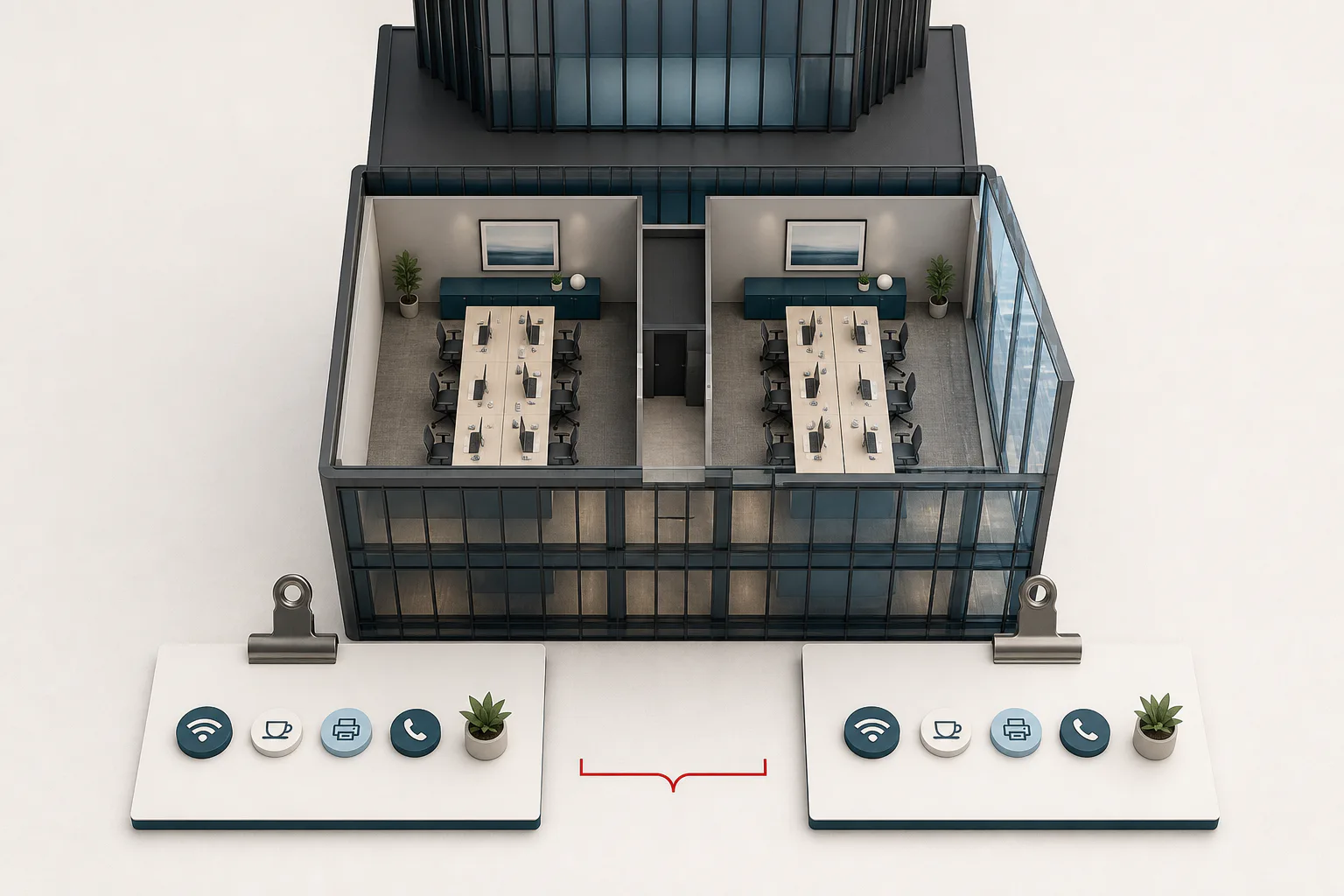
It proves one narrow, useful thing: a building-level starting price cannot describe every serviced office inside the building.
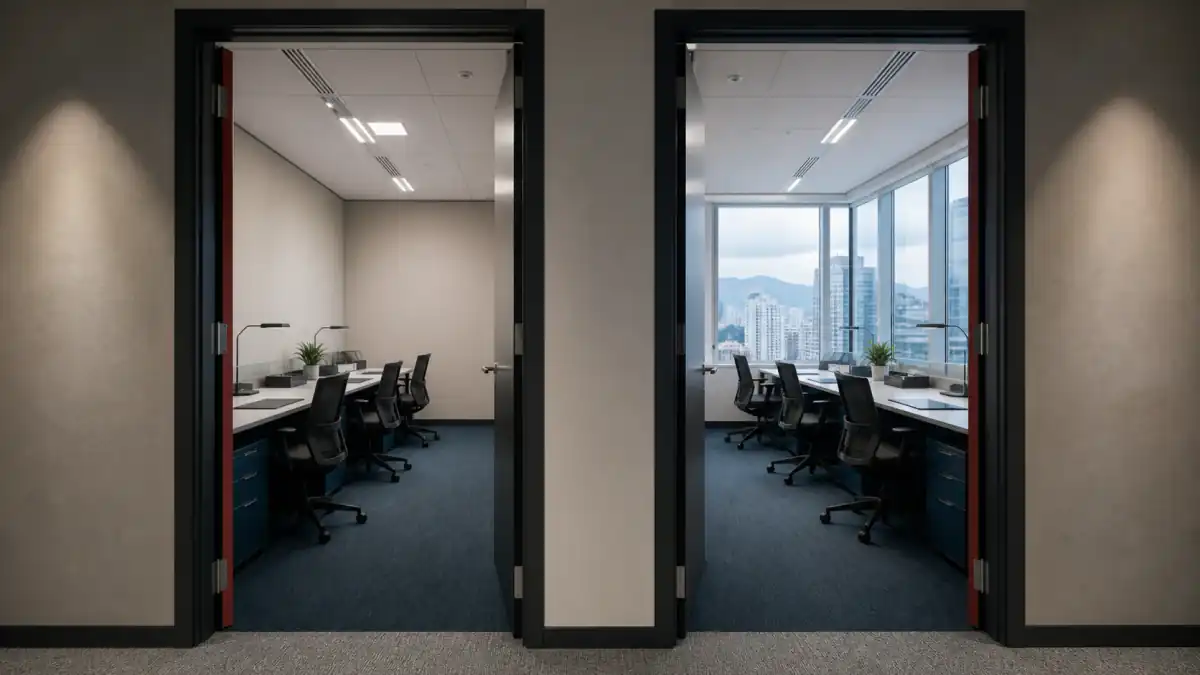
That claim holds because the pair controls for more than a typical website comparison does — same building and address, same operator and centre, same floor, same stated capacity, same source and verification date, and the same broad catalogue fields for furnishing, reception, bookable meeting rooms, Wi-Fi and support. Our source data records two differences: the room identifier, and internal versus window position. And two different prices.
What it does not prove is that a window caused the observed price difference. The source is silent on room dimensions and usable area; shape, columns and door position; desk size and spacing; exact outlook, orientation and daylight quality; acoustics; room-specific furniture and condition; term, promotion or negotiation assumptions; competing demand at the time; whether both rooms were genuinely available for the same start date; and the full room-level inclusion and agreement schedule.
Nor does it prove the dearer room is better — higher quality, easier to negotiate, more productive, better value. Those are decision outcomes, and none of them can be read off a price.
Seven reasons offers differ inside one building
The New World Tower pair isolates one visible variable. Across a real shortlist, there are seven groups to check.
1. Internal, window, corner and outlook
An internal room and an external room are not interchangeable — but "window office" is still an incomplete description. A window can face open skyline, a neighbouring wall, an atrium or a main road, and can deliver useful daylight, glare or heat.
Ask for the exact room number and a marked floor plan; internal, external or borrowed-light position; orientation and what the room actually looks at; whether another building or a fit-out blocks the view; blinds, glare and temperature control; and a viewing at the hour the team would normally be there.
Regus states publicly that its office pricing varies with size, location and position within the centre, window rooms included. That confirms room position is a genuine pricing variable for at least one major operator. It does not establish a market-wide window premium, and it says nothing about how Bela set these two prices.
2. Size, shape and practical capacity
Two rooms advertised for five people can be very different places to work. One takes five desks tightly; the other has circulation, storage or a layout that supports a private call.
Record operator-stated capacity separately from normal and peak attendance, actual desk dimensions and spacing, storage and internal meeting needs, obstructions and circulation, and how many people can genuinely work there in the layout you intend.
A lower per-desk price stops being cheap the moment the room fails that test and the team needs a second office, more meeting-room hours, or another move six months later.
3. Floor and position within the centre
Different floors in one tower can mean different views, lobby experience, lift journey, fit-out, shared facilities, air-conditioning arrangements and even operator brands — one operator may run separate centres or product tiers at a single address.
The building facts stay common. The customer experience starts at the relevant entrance, lift bank and centre reception, so compare the route and the floor rather than the tower.
4. Fit-out, furniture and readiness
One room may be newly finished; another may carry older furniture, a fixed layout, or work that has to happen before you move in. Custom layouts, branding, cabling or security changes add cost, time or both.
Confirm the exact condition and what furniture is included, what has to change before occupation, who pays for it, the operational-ready date, and the restoration obligation at the end. Photographs of the lounge or a sample room answer none of this — view the room and attach dated photographs to the comparison.
5. Shared services and allowances
Same address, different service proposition. Compare reception and visitor handling; meeting-room access, credits and excess rates; call rooms and booths; internet, bandwidth, security and support; printing, beverages, mail and storage; staffed hours against building access; and after-hours air-conditioning.
"Available" is not "unlimited and included". The quotation and agreement schedule should show which basis applies to each offer.
6. Term, start date and live inventory
A price can assume a particular term, start window, promotion or room status. The room next door may be vacant now, occupied until December, under offer, or available only on a longer commitment.
Keep separate: the price verification date; required and offered start dates; fixed or rolling term; quote expiry and hold status; promotion conditions; notice and renewal; and the expansion or transfer route. Two numbers are not comparable just because both say "per month".
7. The denominator
Serviced-office pages quote per desk, per room, per day, per month, or on term-conditioned terms. A difference can be manufactured entirely by the unit.
Keep both figures visible:
whole-room monthly price = quoted room price
derived per-desk starting price = whole-room monthly price ÷ operator-stated capacity
One thing to avoid: dividing by the number of people you expect on an average day and calling the result the operator's per-desk price. Average attendance belongs in the fit test, not in the source price.
A second use case: more than one operator at one address
Lee Garden One shows the other reason to search inside a building rather than stopping at its name. Compass Offices and Regus both publish private-office products at that address, but their public pages do not provide a like-for-like monthly comparison. On the 17 August 2026 source check, Compass expressed its office starting point per desk per month while Regus presented office prices per person per day. The room sizes, term, availability and inclusions were not aligned either.
That establishes multi-operator choice, not an operator premium. Converting the two public headlines into a percentage would manufacture a common basis that the sources do not supply. Ask both operators for current written proposals covering the same team requirement, start date, term, billing period and inclusions; then compare the whole-room monthly totals. Until those inputs match, Lee Garden One belongs on the shortlist but no percentage belongs in the article.
Deciding whether the dearer room is worth it
Start with the team's non-negotiables, not the percentage.
Step 1 — define the room requirement. Normal and peak attendance; time spent in the room versus at client sites; daylight and outlook requirement; confidential-call and acoustic needs; visitor and meeting pattern; layout, storage and IT; required start and term; and the maximum whole-room monthly budget and initial cash.
If daylight is critical, an internal room fails before price enters the conversation. If the team is in occasionally and values the address and the meeting facilities, the internal room stays a serious contender.
Step 2 — compare the exact rooms side by side. View both in the same visit where you can, use one scorecard, label the photographs consistently, and check that the capacity, furniture and condition in the proposal match what you saw.
For this pair the open questions are concrete rather than abstract. Does Room 2138 actually deliver materially better daylight and outlook? Are both five-desk layouts equally workable? Is either warmer, noisier, more exposed to passing visitors, or better suited to confidential work? The catalogue cannot answer any of them.
Step 3 — get quotations on one basis. Same customer entity, team size and room; same start date, agreement term and billing basis; same inclusions and expected usage; same deposit and initial payment; same quotation validity. Where an operator cannot quote both rooms on the same term or start, label the mismatch rather than calculating a premium from two structurally different proposals.
Step 4 — calculate the incremental commitment, but only once the basis is aligned:
monthly room difference = higher whole-room monthly total − lower whole-room monthly total
term difference = monthly room difference × comparable committed months
Keep refundable deposits and one-off costs out of it, and add any differing usage, IT, fit-out or restoration charges rather than assuming the room fee absorbs them. Multiplying that monthly starting difference by a term would be misleading until the same-term condition is confirmed.
Step 5 — record why you decided. One of four outcomes:
- required — the dearer room passes a critical requirement the cheaper one fails;
- preferred and approved — both work, and the team accepts the extra commitment for documented reasons;
- not justified — the cheaper room meets every critical need and the dearer adds nothing valued;
- not comparable — the room, term, service, date or availability evidence is not good enough to say.
That is a more honest record than declaring one room "better value" on price alone.
Same address: what can actually be held constant
| Level | Usually shared | Still needs separate verification |
|---|---|---|
| Same building | Street address and landlord-level context | Operator, floor, room, fit-out, centre services, term, quotation |
| Same operator, same building | Brand and some service systems | Centre and floor, room, inclusions, availability, agreement schedule |
| Same operator and floor | Reception route and most shared facilities | Exact room position, layout, capacity, condition, price, start date |
| Same stated capacity | Operator's desk count | Whole-room total, practical fit, window and outlook, geometry, agreement |
The New World Tower example reaches the third and fourth levels, which is what makes it worth publishing. It still stops well short of a complete transaction comparison.
The standard we hold ourselves to
Before we publish a percentage difference between two rooms, we keep the building ID and both listing IDs; the exact operator, floor and room identifiers; current status and price verification date; the original whole-room price and its published basis; stated capacity and any per-desk calculation; internal, window or outlook evidence; confirmation that both offers share a start-date and term basis; matching inclusions or a visible reconciliation; and an explicit list of what remains unknown.
If any of that is missing, the percentage comes down and the page says comparison requires current written quotations instead. We would rather publish a smaller claim than a tidy one.
The practical lesson
A famous address narrows the search. It cannot choose the room. Inside one building you are still selecting a precise combination of operator, centre, floor, room, capacity, light, fit-out, services, timing and agreement.
Use the building page for shared context, the listing pages to find candidate rooms, then compare written proposals and go and stand in both spaces.
The lower price is not automatically better value. The higher price is not evidence of higher quality. The defensible answer is the room that meets your critical requirements at a total commitment you have accepted — with the difference documented rather than guessed at.
Frequently asked questions
Is a window office always more expensive in Hong Kong?
The two five-person rooms on this page carry different starting prices. That does not establish a market-wide figure, and it does not prove the window alone caused the gap.
Can I compare two serviced offices on per-desk price?
Only where the denominator and the offer basis match. Keep the whole-room monthly total visible, derive per-desk from operator-stated capacity, and compare term, date, inclusions and start conditions alongside.
Does the same building mean the same facilities?
It means the same entrance and landlord context. Centre reception, meeting rooms, lounges, IT, staffed hours and allowances can all differ by operator, floor or plan.
Should I take the cheaper internal room?
Take it if it passes the daylight, privacy, layout, capacity, visitor, IT and timing requirements and the lower total commitment is properly documented. View the exact room first.
Can a catalogue price be treated as a quotation?
No. It is a dated starting point. Current availability, start date, term, deposit, inclusions and final price all require a written operator proposal.
_Research completed 9 August 2026. The New World Tower card displays its own catalogue verification date. Prices and availability change. Reconfirm the exact room, term, inclusions and quotation before relying on the comparison._
Sources and research boundary
- New World Development — New World Tower, accessed 9 August 2026. Used for the building identity and address shared by the compared rooms.
- Bela Offices — New World Tower, accessed 9 August 2026. Used for the centre location and its published private-office and shared-facility context.
- Regus — Office Space, accessed 9 August 2026. Used only for the operator's general explanation that office pricing varies with factors including size, location and position; it does not explain Bela's prices or establish a universal premium.
- Compass Offices — Lee Garden One, rechecked 17 August 2026. Used for Compass's centre, address and per-desk monthly office-price basis.
- Regus — Lee Garden One, rechecked 17 August 2026. Used for Regus's centre, address and current per-person daily office-price basis. It does not provide a monthly figure comparable with Compass's public headline.
The room identifiers, capacities, positions and starting prices come from the dated My Office Asia catalogue records behind the comparison card. They establish a controlled illustration, not the reason for the price difference, current availability or transaction terms. Reconfirm the exact rooms and obtain aligned written quotations before deciding.
Compare two rooms properly
If you are choosing between rooms at one address, send us both listings or both proposals. We will get them onto the same term, start date and inclusion basis, flag what the operator has not answered, and arrange to view them in a single visit.